
If you’ve landed at Melbourne Airport in the last few years, there’s a decent chance someone in plain clothes has walked up to you in the arrivals hall, made eye contact, and asked, “Taxi? Cab? Where are you going?” before you’ve even found your bearings.
Being a first-time visitor, it can feel almost helpful. If anyone who’s flown into Tullamarine more than once, it’s an immediate red flag. That interaction — someone directly approaching you to offer a ride, with no booking, no visible accreditation and no fixed price — is called touting, and it’s one of the most persistent traveler complaints in Victoria. It’s also completely different from what happens when you book chauffeur services in Melbourne through a licensed, accredited provider.
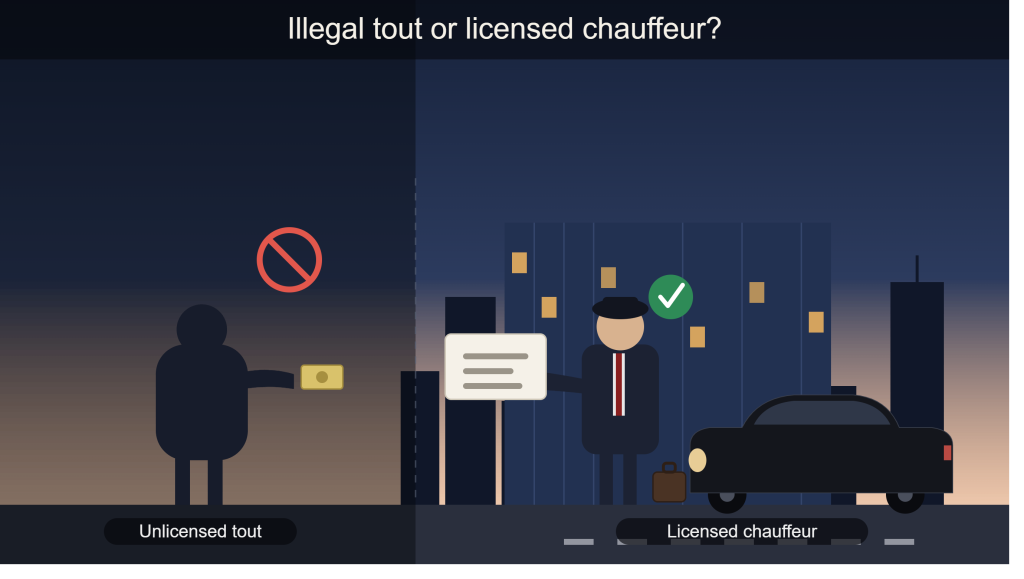
This guide breaks down exactly how to tell the two apart, why the confusion exists in the first place, and what’s changing under Victoria’s rolling 2026 Commercial Passenger Vehicle (CPV) reforms — because those reforms directly affect what you should expect to see, and be shown, the next time you book Melbourne airport transfers.
Why It’s Still a Problem in 2026
Most Australian states treat touting as a straightforward offence. In New South Wales, for example, drivers are prohibited from directly approaching a person to offer a ride without a prior booking, full stop — plain-clothes compliance officers run regular stings at Sydney Airport, and repeat offenders can be permanently banned from the industry.
Read more: Touting and Soliciting Fact Sheet — Point to Point Transport Commissioner, NSW
Victoria’s path here has been messier. Back in 2018, the state government stripped out penalties for taxi touts as part of a broader push to open up the taxi and hire car industry and make it easier for new operators — including rideshare — to enter the market. The unintended side effect was chaos at Melbourne Airport: touts moved into arrivals halls largely unchecked, some legitimate taxi drivers started touting themselves rather than waiting hours in the official holding bay for a short fare, and tourists were left with no easy way to tell who was legitimate.

Read more: Melbourne Airport Taxi Touts Scamming, Harassing Tourists — Australian Frequent Flyer
Public pressure — including a 2019 push in state parliament to reinstate penalties — eventually led to enforcement being rebuilt. Commercial Passenger Vehicles Victoria (the regulator that later became Safe Transport Victoria) now runs overt and covert compliance operations specifically targeting touting at the airport, with on-the-spot fines reported in the range of roughly $1,900, and penalties that can climb into the thousands of dollars for repeat or serious offending. So touting is very much illegal and actively enforced today — the confusion for travellers is less about the law and more about not knowing what a legitimate booking actually looks like.
Read more: CPV Services to Passengers Arriving From a Red Zone — Rod Barton MP
That gap in public knowledge is exactly what touts rely on.
What Touting Actually Looks Like
Touting isn’t always obvious. It’s rarely someone shouting “taxi, taxi” like an old movie. In 2026, it tends to look like this:
- A person in the arrivals hall, baggage claim, or taxi rank approach area who is not wearing visible airport or company identification
- They ask where you’re headed before you’ve asked them anything
- They offer to “help with your bags” as an opener, then steer you toward a vehicle
- There’s no mention of a booking reference, app, or company name — just “come with me” or “I’ll do you a good price”
- The price is quoted verbally, on the spot, with no metre and no fixed quote you can check against anything
- The vehicle is parked somewhere unofficial — not in the taxi rank, not in a marked rideshare pickup zone
- Payment is pushed toward cash, or a card machine that looks improvised
None of this means the driver is necessarily dangerous. But it does mean there’s no accreditation check, no record of the trip, no verified vehicle safety inspection, and no accountability if something goes wrong — whether that’s overcharging, a dangerous driver, or a genuine safety incident. Regulators in both NSW and Victoria have flagged the same core issues with touting: it leaves passengers with zero verification that the driver or vehicle has passed any safety check, and it strips away the paper trail that exists the moment you make a proper booking.
Read more: Touting and Soliciting Fact Sheet — Point to Point Transport Commissioner, NSW
For solo travellers, women travelling alone late at night, older parents being collected by family, or international students arriving in Australia for the first time, that lack of a paper trail is the actual risk — not just the price.
How to Spot Genuine Chauffeur Services in Melbourne
A genuine, accredited chauffeur operating Melbourne airport transfers will look and behave nothing like this. Here’s what to actually check for.
1. You booked in advance, and you have a reference.
Legitimate chauffeur services in Melbourne are booked ahead of time — by phone, app, or website — and you’ll receive a booking confirmation with a reference number, driver name, and vehicle details before you land. If someone is offering you a ride you never booked, it is not a chauffeur service.
2. The driver is holding a name sign, not asking “where are you going?”
A chauffeur who has your booking will be standing quietly, usually near the arrivals meeting point, holding a sign with your name or your company’s name on it. They won’t need to ask where you’re going — they already know. Under point-to-point transport law, this is explicitly carved out as not touting: a driver checking whether someone is their pre-booked passenger is completely different to a driver fishing for any passenger they can find.
3. There’s a visible CPV identifier and, increasingly, a QR code.
Every Commercial Passenger Vehicle registered in Victoria — taxi, rideshare, or hire car — is required to display identification showing it’s an accredited CPV. As part of the 2026 reforms (more on this below), CPVs are also required to display an official Safe Transport Victoria QR code that lets passengers report safety or fare concerns directly to the regulator. If a vehicle has neither, be cautious.
Read more: QR Codes for Commercial Passenger Vehicles — Safe Transport Victoria
4. The price was fixed before you got in the car.
Reputable chauffeur companies quote a fixed, all-inclusive fare (or a clear hourly rate) at the time of booking — not a number pulled out of thin air at the kerb. If you’re being asked to negotiate a price standing in arrivals, that’s not how licensed booked services work in Victoria.
5. The vehicle is where it’s supposed to be. Licensed chauffeurs park in designated pickup zones or short-stay areas, not idling near the terminal doors trying to intercept people walking out. If a car pulls up somewhere unofficial the moment you make eye contact, treat that as a warning sign, not a convenience.
6. The driver is affiliated with a specific, named company — and only that company.
Under the newer signage rules, drivers are only permitted to display branding for the booking service provider they’re actually affiliated with at that moment. A driver flashing multiple companies’ signage, or none at all, isn’t operating the way an accredited chauffeur service is required to.
Read more: Victorian Government CPV Reforms: What Drivers Need to Know — Safe Transport Victoria
Quick Comparison
| Illegal Tout | Licensed Chauffeur | |
| Approach | Approaches you first, unprompted | Waits with a name sign for a pre-booked passenger |
| Booking | None | Confirmed in advance with a reference number |
| Pricing | Verbal, negotiable, on the spot | Fixed quote agreed before travel |
| Identification | Little to none | CPV identifier + QR code + company branding |
| Vehicle location | Unofficial, near terminal doors | Designated pickup zone |
| Payment record | Often cash-only, no receipt | Invoiced, trackable, receipted |
| Accountability | No verification of driver or vehicle | Accredited, background-checked, regulated |
Victoria’s 2026 CPV Reforms Explained
This is the part most travelers — and honestly, quite a few operators — haven’t fully caught up on yet. Victoria has been rolling out a significant set of Commercial Passenger Vehicle reforms throughout 2026, following the Transport Legislation Amendment Bill 2025. They’re being introduced in stages rather than all at once, and while a lot of the headline coverage has focused on taxis and rideshare, several of these changes directly affect what a passenger booking a chauffeur should expect to see.
Read more: Commercial Passenger Vehicle Industry Reforms — Victoria State Government
From 1 January 2026 — tougher penalties for fare manipulation. Penalties for meter-related offences during unbooked (rank and hail) trips increased sharply — the on-the-spot infringement rose from roughly $509 to around $814, and the maximum penalty a court can impose doubled. This mainly targets taxis and rideshare rather than pre-booked chauffeur trips, but it signals the regulator’s broader direction: fare transparency is now a genuine enforcement priority, not a guideline.
Read more: Penalty Increases for Meter Offences Start 1 January — Safe Transport Victoria
From 1 March 2026 — mandatory QR codes and stricter signage rules. Every Commercial Passenger Vehicle in Victoria, including hire cars used for chauffeur services, is now required to display an official Safe Transport Victoria QR code while providing a service, unless the operator has an approved alternative digital complaints pathway. Scanning it takes a passenger straight to a channel for reporting safety concerns or fare issues directly to the regulator — which is genuinely useful information for a nervous first-time traveller to know exists. Alongside this, drivers are now barred from displaying signage or branding for any booking service provider they aren’t actually affiliated with at the time, closing a loophole that let some operators appear more “official” than they were.
Read more: Victorian Government CPV Reforms: What Drivers Need to Know — Safe Transport Victoria
From 1 July 2026 — affiliation, camera and audio requirements tighten further. Booking Service Providers must now take active steps to confirm their affiliated drivers are correctly displaying the required QR code or an approved digital equivalent, and drivers are required to update their BSP affiliation details in the ST Vic portal. For unbooked vehicles specifically, camera footage retention was extended from 72 hours to 14 days, and audio recording became mandatory alongside video — a change aimed squarely at improving the evidence trail if something goes wrong. The “two-strikes” disciplinary framework, which can permanently remove a driver’s accreditation after repeated serious offences, also expanded from this date.
Read more: Remaining CPV Reform Changes to Commence From July and August — Safe Transport Victoria
From 1 August 2026 — broader incident reporting. Booking Service Providers and drivers must now report a wider range of incidents to Safe Transport Victoria, including allegations of overcharging, excessive non-cash surcharges, refusal of assistance animals, and refusal of service — building a public accountability record that didn’t really exist in this form before.
Read more: CPV Industry Reforms overview — Safe Transport Victoria
What this actually means if you’re booking a chauffeur
For a passenger booking chauffeur services in Melbourne rather than hailing a taxi at the rank, the practical takeaways are:
- You now have a legitimate, government-backed way to verify or report a driver on the spot, via the QR code — ask to see it if you’re ever unsure.
- Genuine operators will be affiliated with one clearly identifiable brand, not several — inconsistent signage is now a compliance red flag, not just an aesthetic one.
- The regulator’s enforcement appetite has visibly increased across 2026, which is good news if you’ve ever been overcharged or felt unsafe and didn’t know where to report it.
- None of these reforms make touting itself newly illegal — it already was — but they do make it considerably easier to prove the difference between a compliant chauffeur and someone operating outside the system, because compliant operators now carry more visible, checkable evidence of their accreditation than they did even twelve months ago.
If an operator can’t show you a QR code, consistent single-company branding, and a CPV identifier, it’s worth asking why — regardless of how professional the car itself looks.
Here’s What to Actually Do
- Don’t engage past a polite “no thank you, I have transport booked.” You don’t owe an explanation.
- Keep walking toward your actual pickup point or the official taxi rank. Touts rely on you to stop and think.
- If it feels aggressive or you feel unsafe, alert airport security or Victoria Police, who have a visible presence at Melbourne Airport.
- If you want to report it after the fact, Safe Transport Victoria accepts reports of touting and other CPV compliance issues, and your report contributes to the ongoing compliance operations targeting this exact behaviour at the airport.
- If you’re not sure whether the person offering you a ride is legitimate, ask directly for their CPV identification and the QR code. A genuine driver will produce both without hesitation. Someone touting will not.
Important Note for New and International Travellers
If you’ve just landed in Australia for the first time — as an international student, a new migrant, or a visitor unfamiliar with how ground transport works here — this entire situation can feel disorienting after a long flight, and that’s precisely when people are most vulnerable to being overcharged or led somewhere they didn’t intend to go. The single most protective habit you can build is simple: Book your transfer before you fly, not after you land. Whether that’s a chauffeur, a pre-booked rideshare, or an official taxi, having a confirmed reference number and driver details in hand before you walk into arrivals removes almost all of the uncertainty that touts are designed to exploit.
No matter if you book for business travellers, event guests, and families being collected for weddings, milestone birthdays, or hospital transfers, the same principle applies — a confirmed booking with a named driver and a fixed fare isn’t just more comfortable; it’s the difference between a documented, accountable trip and one that leaves no trail at all if anything goes wrong.
Frequently Asked Questions
- Is touting illegal at Melbourne Airport?
Yes. Although Victoria briefly removed penalties for touting in 2018, enforcement has since been rebuilt, and Safe Transport Victoria actively runs compliance operations targeting touts at Melbourne Airport, with significant on-the-spot fines for offenders.
- How do I know if a chauffeur company is actually licensed in Victoria?
Check for a visible CPV identifier on the vehicle, a Safe Transport Victoria QR code, single-company branding matching who you booked with, and a confirmed booking reference before you travel. You can also verify accreditation through Safe Transport Victoria’s public CPV register.
- What’s the difference between a booked and unbooked CPV service?
An unbooked service is a rank-or-hail trip, like flagging a taxi. A booked service — which covers chauffeurs and pre-arranged hire cars — is arranged in advance with a confirmed driver, vehicle, and fare. Most 2026 reforms tightening fare and camera rules focus heavily on unbooked services, though QR code and signage requirements apply broadly.
- What should I do if I’ve already paid a tout and feel I was overcharged?
Report it to Safe Transport Victoria with as much detail as you can recall — vehicle description, approximate time, location, and payment amount. It won’t necessarily recover your money, but it feeds directly into the compliance operations targeting this behavior.
- Are QR codes required on chauffeur vehicles too, or just taxis?
The QR code requirement applies to all Commercial Passenger Vehicles, including hire cars used for booked chauffeur services, unless the operator has an approved alternative digital complaints pathway in place.
What’s the bottom line: Touting at Melbourne Airport isn’t a grey area, and it isn’t going away on its own — but 2026’s reforms have quietly handed passengers more tools than ever to tell a compliant operator from someone working outside the rules. Book ahead, know what a genuine confirmation looks like, and don’t let a long-haul flight talk you into skipping the checks that actually keep you safe.
